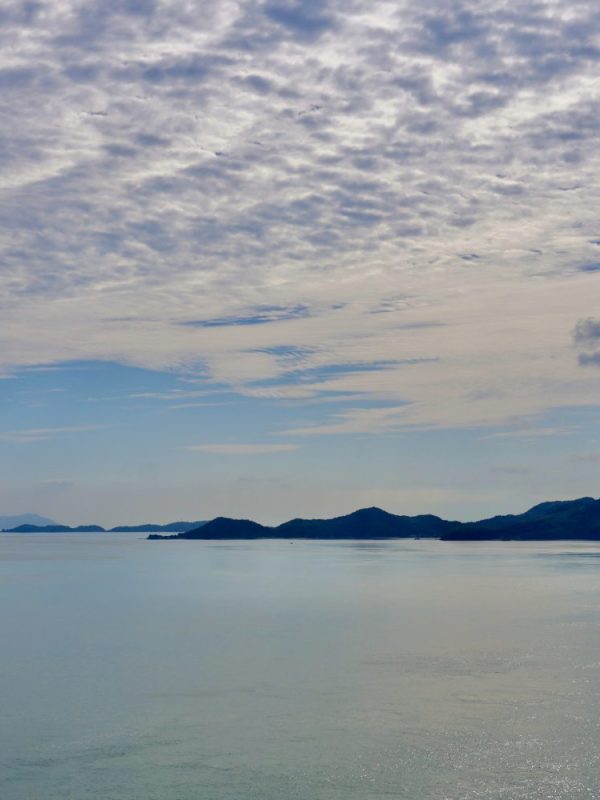
We’ve been told no trip to Japan is complete without a cycling tour of some kind. We choose the Shimanami Kaido route, across several Seto Inland Sea islands; it’s said to be the most scenic. The starting point is Onomichi, a coastal town just south of Okayama, a short half hour train ride away.
Onomichi is a small city of just 130,000 people. The port dates to the 12th century and is active to this day. We’re only here for a night, staying at the Onomichi Lemonsea hotel https://www.agoda.com/lemonsea-onomichi/hotel/onomichi-jp.html?cid=1844104&ds=xYGeGSwsniXHuw%2Bz. It’s a boutique guesthouse with a modern minimalistic aesthetic.
The town has more than its share of temples and shrines, castles, museums and parks, given its size. We’re not here long enough to see more than a few of them. Most notably we see our first cats of the trip, along a portion of a temple walk called “cat alley”. Everywhere else in the world we’ve travelled we encounter cats, and some places, like Dubrovnik, have a few too many! As long as the waiters don’t shoo them away, these critters hang around the restaurants hoping for a morsel of fish or chicken. I’ve been know to surreptitiously slip a bit of my meal to a cat sitting patiently under the table.
Here in Japan we see no cats and are told that they are kept inside as pets, never allowed out on the street. Even if there were strays, what would they eat? The streets here are spotlessly clean. Nary a scrap of food or any other kind of garbage is to be found. The “cat alley” cats are definitely alley cats, bearing battle scars. We see food and water bowls set outside of doorways and even a few cushions… these cats are obviously community cats rather than strays.
The first day of biking dawns sunny and warn. YAY!! We meet our tour operator, drop our bags (they’ll travel by van to our hotels) get our bikes, a map and a few instructions and head off on another adventure. A short ferry ride gets us to the first island and the well marked bike path. Turns out it’s not that well marked and within a half hour we are lost, having needlessly ridden up a steep hill that we thought would get us onto our first bridge. Google maps to the rescue yet again. Down the hill we coast, back to where we veered right instead of left and from there on we are fine. The scenery would be beautiful if not for the many ports with their cranes and cargo ships. Never mind, we are too focused on the blue path markers to look beyond the pavement in front of us.
We make it to the first hotel, the Tsutsui Ryokan https://www.tripadvisor.com/Hotel_Review-g651649-d1075703-Reviews-Tsutsui-Onomichi_Hiroshima_Prefecture_Chugoku.html, in Setoda, a port town on Ikuchijima Island. The lobby is no great shakes, but the room is clean and has an enclosed balcony overlooking the Seto Inland Sea. A ryokan is a traditional Japanese inn. More than just a place to sleep, a ryokan offers a variety of culturally immersive experiences. Tatami matted floors (take your shoes off!), robes & slippers, meals, and an onsen. Our onsen is a smallish – big enough for 6 people – cedar tub filled with natural spring water and sliced limes and lemons. We’ve never seen anything like it!!
Besides bikers, the town is known for its lemons and myriad lemon products. Temples too! We’re here for a night so we don’t see much of the environs. And because dinner at the hotel is included in our tour package we don’t have to tromp around looking for a restaurant. Dinner is an event, to say the least. I lose count of the number of courses, the number of tiny dishes with delicate tidbits. Craig & Geoff eat their fish raw; Seonag & I pop ours into little ceramic cookers. The food keeps coming! Just when we think the meal is over we’re served rice, tempura, and miso soup. By the time desert arrives we are well and truly fueled up for tomorrow’s ride.
I can smell breakfast the next morning before I see it… another feast in tiny containers laid out on the table. It smells like the ocean. More raw fish. Don’t get me wrong, I enjoy a bit of sashimi from time to time, but not at 0730. Craig & Geoff are digging in. Seonag’s got a cup of coffee and a few pastries. I don’t even sit at my place setting. Pickles, fish, tofu and congee… no thanks. I too eat a few pastries and am glad for the fruit smoothies I’d bought yesterday to take on the road.
We’re off riding early-ish, 0900. It’s an overcast day, perfect for riding, especially up the hills leading to the bridges. Thankfully the Japanese have constructed gently (kinda) sloping access paths for us bikers. But it’s still a climb. Soaring down is exhilarating and an opportunity to stand up and lift our bums off the seats. Shoulda brought some cycling shorts with extra padding!
The route is less interesting and scenic than billed. Too much industry… ports, tankers, cranes. The villages we ride through are rather deserted and forlorn. Where is everybody? We are getting into the off-season, so there are fewer tourists, but where are the locals? Dunno.
We make it to our hotel, the Sea Inn Sennen Matsu https://www.tripadvisor.com/Hotel_Review-g1022356-d1790076-Reviews-Umiyado_Sennenmatsu-Imabari_Ehime_Prefecture_Shikoku.html, by mid-afternoon. It’s in a secluded location, away from town, and there’s little to do apart from rest and relax, which suits us fine. Our room has a large balcony overlooking the sea. A perfect place to just sit, do nothing, let the zen vibe of the place quiet my monkey mind. AHHHHH!!! There’s even room to do a bit of yoga and free some of the knots in my thighs. OMMMMMM!!!
Then it’s off to the onsen, the Japanese version of a spa. There’s a page of rules for use of the onsen; one must be naked and thoroughly washed before entering, one must sit on a stool to wash, one must not add cold water to the pool, even if it is too hot. I manage those rules just fine. And the experience is wonderful… relaxing, soothing, restorative.
It’s when I get out that the problem arises: I can’t find the towels. I look everywhere in the change/grooming room. At a point I consider using one of the blow dryers on my dripping wet body. The other women all have towels and it takes a bit of gesticulating to make them understand what I am in need of. A lovely young girl offers me hers. She’s now clothed and drying her hair so she’s obviously used it, but she keeps pushing it toward me, and even though I’m not keen on a used towel, I take it. Mysteriously, and mercifully, it is dry. Did she not use it? How did she dry herself? I wonder how Craig is faring next door in the men’s onsen? Back at the room, as we swap stories, he tells me he figured out before he got in the pool that there were no towels and wisely retuned to our room to get one. I hope to not run into the towel-giver at dinner. I’m already embarrassed enough.
Dinner is another seven course extravaganza: apple salad, raw fish, cooked fish, more fish, pickled veggies, rice, miso soup, fruit. At first I am leery, but hunger and the lack of alternatives compel me to dig in. Apart from the skewered octopus – just couldn’t do it – the meal is delicious and satisfying. The cycling, the onsen, the meal… we are tired and in our rooms early. ZZZZZZZZZ!!!
The last day on our bikes is another sunny, warm one and the ride is short, just 20ish kilometers. We cross a “really big bridge”, the Kurushima Kaikyo, the world’s first triple-tower suspension bridge structure. It spans 4,105 meters (about 2.5 miles) across the treacherous currents of the Kurushima Strait.
When completed in 1999, it was the world’s longest suspension bridge. (The Canakkale bridge in northwest Turkey spans the Dardanelles Strait is currently the longest) Consisting of three successive suspension bridges with six towers and four anchorages, the main towers of the Kurushima Kaikayo bridge stand approximately 600 ft above sea level. The road deck, where we ride in a lane separate from the vehicular traffic, stands 180 – 200 feet above sea level.
About 3/4 of the way across the bridge we access an elevator that takes us down from the bridge deck to Uma Island where we ride along the shore and explore a small temple. Back up the elevator and onto the bridge we are close to our destination, Imabari. Once there we drop our bikes at the train station, pick up our bags, jump on a train and are soon in Matsuyama. A short taxi ride has us at the Dormy Inn https://japantravel.navitime.com/en/area/jp/spot/01140-AG2796127/.
Matsuyama is a mid-sized city that dates back to the 6th century but looks new as it was bombed toward the end of World War II, with 251 civilians killed and over 55% of the city area destroyed. We are here for only two nights and mostly because of the airport. The next leg of our journey is in the mountains of central Honshu and the fastest and easiest way to get there is by air.
While I’ve not savoured the ryokan food per se, I have enjoyed the food experience. The tiny, delicate courses made with such care and attention to detail have to be admired. Even the raw fish is palatable as it is fresh and carefully prepared. But here in Matsuyama we are hungry for something rib-sticking. Unfortunately it is Saturday night, we have no restaurant reservations, the burger restaurant recommended by AI is not where google maps says it should be and we spend a lot of time searching for a suitable venue. Just as I am about to duck into 7-11 for an egg salad sandwich an Italian trattoria miraculously appears. Another plate of pasta in a country renown for it’s cuisine. Sigh!
There is a castle here, situated high on a hill in a large leafy park. Craig, Geoff & Seonag head up early in the morning of our one day here. I take some time for myself. Time to do a bit of yoga, laundry, wander the remarkable galleria mall just outside the front door of our hotel, and an art gallery with some colourful art. Strolling down a street of shops I find myself at the base of both a cable car and a chair lift, called a “ropeway”, going to the the castle. Up I go. With no safety bar or seat belt it feels a bit loosey-goosey, especially for a place with as many rules as Japan.
The castle is impressive: large, ornate and towering over the town. Built in 1603, blah, blah, blah… nobody, including me, is really interested an any more castles, much less their history. I snap a few photos, eat an ice cream cone and walk down; the ropeway descent does not entice.
From Matsuyama we fly back to Honshu island, to Nagoya, where we catch a train to get to Nakatsugawa, a small town in the mountains east of Tokyo, in the Japan Alps. Stay tuned!