Okayama … not to be confused with Osaka or Okinawa or Yokohama or even Oyama (as Craig often calls it). We wonder if the Japanese have as much trouble with our place names? Saskatoon, Saskatchewan must be a mouthful!
Two hundred kilometres south of Kyoto, the bullet train gets us to Okayama in just over an hour. Yes, they do travel 200 kph!!
With a population of around 800,000 Okayama is a small city by Japanese standards. As soon as we step out of the train station we sense that the buzz here is more subdued than either Tokyo or Kyoto. Our hotel, the Koraku https://www.korakuhotel.jp/english/ is a short walk from the station, just a block past the tree-lined Nishigawa canal that runs the length of the city.
We continue to find Japanese food disappointing. Evenings are often spent traipsing from restaurant to restaurant in search of something edible. Our first night here is no different. As well, it’s Saturday and places are full. We luck out on an American bistro where we finally find a green salad on the menu. Heaven!!
Our first day of sightseeing is a Sunday; the streets in the morning are deserted and quiet. But the art galleries are open. The two we visit are housed in grand modern concrete & steel buildings that are art in and of themselves. In fact, they are more artistic than the art inside.
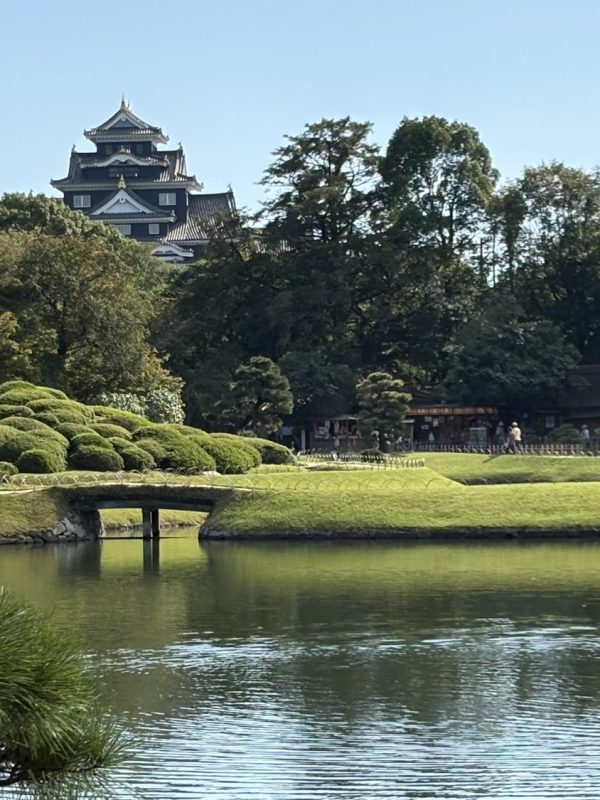
Google maps leads us to a quaint river-side cafe for lunch. We luck out on another great meal with lots of tasty little vegetable dishes. A walk along the river, the Asahi – same name as the beer – leads to Okayama Castle. Dating back to 1570, the castle has been destroyed and rebuilt several times. Today it is black with white trim and gold ornamentation in the shape of a fish. Inside is a museum focused on the history of Japan’s emperors.
Across the river, on an island, is Koraku-en, a spacious garden that incorporates the typical features of Japanese landscaping, including a large pond, streams, walking paths and a hill that serves as a lookout point. It’s lovely but too hot for much of a tour around the 35 acres.
Walking back to the hotel we take a wrong turn and end up “lost”. Hearing loud strains of Frankie Valli’s “You’re Just Too Good To Be True” being played by what sounds like a large orchestra, we follow our ears into a galleria-type mall. Sure enough, several marching bands, baton and banner twirling troupes of brightly costumed girls and enthusiastic spectators fill the mall. We have no idea why or what the occasion for the performance might be, but we’re grateful we took that wrong turn. And thanks to google maps we find our way back to the hotel.
Part of the point of being in Okayama is a day trip to Hiroshima, site of the first detonation of an atomic bomb on a populated area. On August 6, 1945 the bomb, paradoxically named “little boy”, was dropped from the American bomber Enola Gay. Most of Hiroshima was destroyed, and by the end of the year between 90,000 and 166,000 had died as a result of the blast and its effects.
To add insult to injury, on September 17, 1945, Hiroshima was struck by Typhoon Ida, wreaking more death and destruction. In the years following, cancer rates soared and many more people died of leukemia, lung, stomach, breast, colon, liver, and thyroid cancers. It is a testament to the spirit of the survivors and their heirs that the city today is a bustling metropolis of 1.2 million people.
The Hiroshima Peace Memorial Park is a UNESCO World Heritage Site and serves as a commemoration and remembrance of the bombing. The site consists of a museum, the ruins of a building – Hiroshima Prefectural Industrial Promotion Hall – that survived the blast, an eternal flame, a peace bell, a “little boy” tower, and a children’s peace monument.
The time spent inside the museum is a very somber reminder of the horrors of war, especially nuclear war. The exhibits pull no punches; they are graphic and grotesque. I have to look away from some of the photographs of the burns and disfiguring injuries. Craig finds the display of children’s tattered and burned clothing especially dismaying. A few of the kids who are in the museum with their parents are visibly upset. I find myself moving along at the same pace as a couple of young girls, both clearly disturbed by what they are seeing.
It’s hard to segue from Hiroshima to Figo, the teeny but stylish Italian canal-side eatery where we spend the evening. We talk about how the Japanese people seem to have moved on from Hiroshima. And Nagasaki, where a second atomic bomb was dropped on August 9, 1945 at 11 AM. All of the Japanese we have encountered on this trip have been unfailingly polite, gracious, friendly and helpful. We wish we knew more of their language so we could do more than just bow and say konichiwa and arigato.
We also notice that the Japanese, particularly the women, young and old, and to a lesser extent the men, are extremely stylish dressers. They have a flair that rivals what we see in Paris and Rome and other major fashion centres. Thus far I have resisted making any clothing purchases, but a day trip to Kurashiki Bikan will change that.
A short train ride from Okayama, Kurashiki Bikan is a gem of a place. Especially the old merchant quarter, called the Bikan historical area. It contains many fine examples of 17th-century wooden warehouses painted white with traditional black tiles, along a canal framed with weeping willows. The canals were initially built to allow boats and barges to navigate between the city’s storehouses and the nearby port on the Seto Inland Sea. Today koi fish, swans and wooden boats propelled by straw-hatted oarsmen grace the canals, making for a very picturesque scene.
As well, wooden shops selling all manner of artisanal products, from clothing to shoes to ceramics to baked goods tempt us to spend some of our yen. Because we still have two weeks of travel, including three days of biking, I limit my purchases to a couple of pieces of fabric and a stylish blouse.
Lunch is worth a mention. We’ve given up on Japanese food and are eating mostly Italian and Indian. In Kurashiki we find a small cafe serving curries and the most amazing fruit frappes. We opt for the 1000 calorie mango version, complete with ice cream, frozen mango chunks, and a syrupy mango reduction swirled on top. It’s decadent and delicious.
The Ohara Museum of Art is a surprise. Established in 1930 by Magosaburō Ōhara, it contains paintings by many European masters: El Greco, Monet, Matisse, Gauguin, Picasso, Modigliani, and Renoir. As well, there are a few Jackson Pollocks and an Andy Warhol. We did not expect to see a collection of this calibre in a wee town in Japan.
Thus far the only thing we dislike about Japan is Japanese food, so for our last night out in Okayama we head to an eatery called Boston Steak. Very American. Except for Craig’s romaine salad. The lettuce is served hot and garnished with “whitebait”. At first it looks like bits of ramen noodles, but closer inspection and a quick check of the internet reveals it to be tiny, immature fish. Ugh!
Okayama is not a flashy tourist destination. There are no over-the-top neon alleys, no gobsmackingly beautiful shrines or temples, no geishas, no volcanos. Our time here has been pretty chill. After the zaniness of Tokyo and the eye-popping religious sites of Kyoto we’ve appreciated the slower pace of Okayama. Fingers crossed we are rested up for our bike tour!