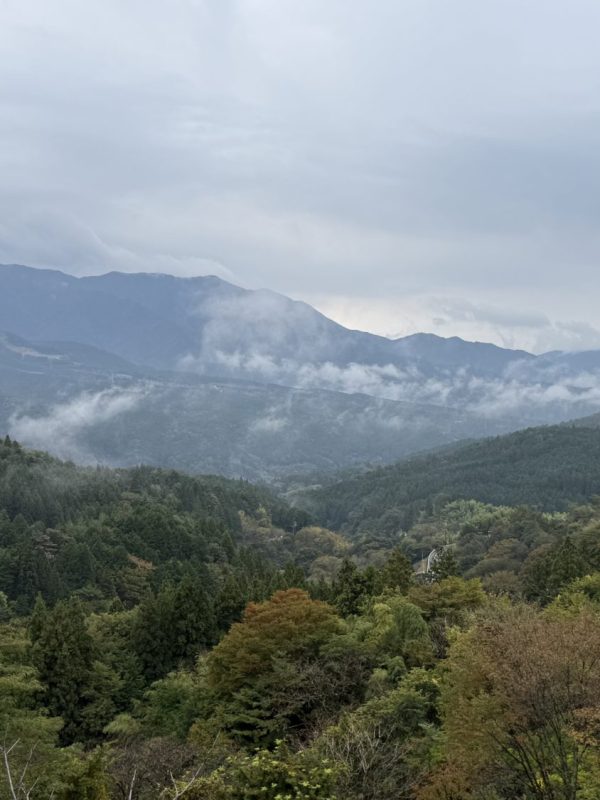
Bisecting the island of Honshu, the Japanese Alps are home to Japan’s highest mountains, numerous Buddhist monasteries and old “post towns”. Our first stop is Nakatsugawa, a small city with not a lot to draw visitors apart from hiking. The Onn, https://onnnakatsugawa.com-hotel.info/ our hotel, is new and modern and not at all what we expected in such a dinky town. The restaurants, however, are exactly what we expected: Japanese. At the Chicken House, the only western style eatery we can find, I am embarrassed to say I order chicken fingers & fries.
We hear the rain through our open windows the next morning. It’s our only day here to do the Nakasendo hike so we put on our rain jackets and get on the bus headed to Magome, the starting point. Also called “The Samurai Road” the trail takes us from Magome to Tsumago through forests, along the Kisu river gorge. Magome and Tsumago are both “post towns”. During the Edo period (17th – 19th centuries) these towns were rest stations along major transportation routes. The one we are on, the Nakasendo trail, connected Tokyo & Kyoto and would have been a busy route back in the day. Today it is crawling with tourists.
Some of the post towns, such as Magome & Tsumago, are well preserved and, to some degree, restored. Not surprisingly many of the old wooden buildings are now souvenir shops, restaurants and bars. Welcome to the 21st century!
We get a bit of rain & mist and a mostly cloudy day but given the 20+ degree temperature and the humidity we are glad to not be hiking in sunny weather. The 8 km route takes us 5 hrs to cover and we’re at the Tsumago bus stop just in time to hop on and get back to our hotel in decent time. Then it’s off to the onsen to soak and relax before dinner at a surprisingly good Japanese restaurant.
Every once in a while we get a gem, a Japanese meal that I can savour. Tonight’s is pork fried rice and terriyaki chicken. Doesn’t take much to satisfy me and I’m reminded of how spoiled we are in Canada, having so much culinary variety, even in Vernon. Here it’s either Japanese food, maybe Italian, and sometimes curry. Even in the larger cities there is a dearth of global cuisine. Don’t the Japanese get tired of their own culture’s food?
We’re only in Nakatsugawa for two nights and then it’s a triple train travel day to get to Takayama. Thankfully the trains run on time, to the minute, so we don’t have to worry about one train being late, making us miss the next one. But the station stops are so brief that if you blink at the wrong time or, worse, take an ill timed bathroom break, you might miss your train. Ditto for getting off. You’d better be at the exit door, bags in hand and ready to jump onto the platform or you’re going to the next town.
We have exactly four minutes in Mino-ota to change trains. It’s tight but we make it and arrive in Takayama about the time that our hotel check-in opens. The Around https://hotel-around.com/takayama/ is a short walk from the train station and is close to some interesting looking cafes and sake bars. This just might be where we try some of the local sake.
Takayama is a small city of just under 90,000. The high altitude and separation from other areas of Japan kept the area fairly isolated, allowing Takayama to develop its own culture. That explains the well-preserved Edo-period merchant quarter. Besides sake, Takayama is known for its local Hida beef and scenic alpine backdrop.
Because we are here for three days we have time to take a day to randomly wander the streets, free to discover whatever we encounter. A market, several temples, a couple of museums, a bookstore, a Muji department store and an Indian restaurant for lunch. Then an afternoon of leisure. A nap, some reading, a soak in the onsen.
Although Takayama is said to be the heart of Japanese gastronomy, we keep our expectations realistic. So we are pleasantly surprised to get some great meals here. In particular an evening at Eviltex is cause for celebration. Burgers, burritos, quesadillas, mango mojitos. We walk back to our hotel with full bellies.
An hour bus ride away is Shirakawa, a World Heritage site. A traditional village, it is celebrated for preserving a centuries-old rural way of life. The A-frame thatched roof dwellings are constructed without nails; the frame is lashed together with rope. The sharply sloped roofs are intended to shed winter snow and are modelled on the shape of hands in prayer.
I wonder what the 1,600 local residents think of us trooping through their village. The many signs prohibiting all kinds of behaviour suggest they may be none too pleased!
On the other hand, 70% of the residents work in the tourist industry and the local economy is highly dependent on tourism. However, the increasing number of visitors causes damage to the area from pollution. And local inhabitants turning their homes into hostels, gift shops and parking lots has endangered Shirakawa’s World Heritage status. There is also fear that catering to tourists will alter the charm of the area’s picture post card perfection.
Were it not for the 14 tunnels along the road between Takayama and Shirakawa the trip would be much longer, with many switchbacks. The route is through steep mountainous terrain but the bus pretty much travels as the crow flies, in a straight line. Of the 50 km distance, 40 km (80%!!) are spent in tunnels. We literally tunnel through the mountains. Two of the tunnels, the Kotori (4,530 meters) and the Hida (10,710 meters) are particularly long. While China has more highway tunnels than Japan, Japan has more tunnels per kilometre of road. Both countries have more tunnels than any other country on the planet.
It’s raining our last day in Takayama, ideal weather for museums. The hour long walk to the first one takes us through suburban Takayama; an opportunity for a real estate tour. The lack of colour in Japanese exteriors is something we’ve noted throughout the country. Lots of brown & cream in the older houses. The newer ones look very similar to what we see in contemporary Canadian housing: square, geometric shapes and lots of black & grey with wood accents. Who’s copying who, we wonder?
Hikaru museum is housed in a building that looks a lot like a Mayan temple. Inside is an exhibit presenting a comparative study of the Japanese Samurai (Bushido) and the European Knight (Chivalry) cultures. Turns out there are many similarities: honour, generosity, courage, loyalty, charity, to name a few.
Another exhibit is an overview of the history of art, beginning with cave drawings. There are a few Monets and a Renoir (not their best works) and a room full of paintings by a modern Japanese female artist named Tada Yuko. A curry lunch in the museum cafe fuels us for a walk across town to the Takayama museum of art & history. It’s free admission and rather ho-hum. Craig wants me to say that he disagrees and finds the museum informative and enjoyable. Maybe I’m just museumed out?
Around the corner is Hirase Sake Brewery and Tasting Room. Properly called nihonshu, sake is made by fermenting rice, water, yeast, and koji mold, and has an alcohol content of around 15%. Koji mould, a fungus grown on rice, is said to be healthy because of the beneficial enzymes. Sounds vile. Of the twenty bottles we sip from only one is palatable: a citrusy yuzu sake, so good that I buy a couple of bottles.
Takayama is famous for its Hida beef, a variety of Wagu beef known for intense, snow-like marbling, a butter-like melt-in-your-mouth texture, and a slightly stronger beefy flavour than Kobe beef. Takayama Hida beef is said to be descended from Yasufukugo, a prized bull who lived in the area in the 1980s.
Eager to try some, we make a reservation at a neighbourhood yakisuki restaurant, where we cook our beef and veggies ourselves on a gas grill set into the middle of the table. Yakisuki is a Japanese cuisine that combines the cooking style of yakinuki (grilling) with the sweet & savoury flavours of sukiyaki.
It’s not inexpensive, but it’s worth the cost. We get a salad! Veggies! The Hida beef is uber-tender. Over dinner we talk about our time in Japan, how it’s affected us, changed us. As always with travel to the “old world” we are struck by how western-centric our values and perspectives are.
Being in Japan has given us an appreciation for the deeply-rooted traditions of a culture that is centuries old, a culture that does not embrace or emulate America (even though there are many Starbucks here), a culture where decorum and politeness and kindness matter. In a world that seems to be spinning out of control it’s been comforting to be in a country that, on the surface, seems to be calmly getting on with the ordinariness of life & living. Notwithstanding the 2 earthquakes in the past 24 hours, 7 earthquakes in the past 7 days, 46 earthquakes in the past 30 days and 766 earthquakes in the past year, Japan feels stable and safe. And even though typhoon Champi is predicted to make landfall close to Tokyo next week no one is panicking. It’s just not the Japanese way.