A bullet train ride away from Tokyo, Kyoto could be on another planet. Whereas Tokyo is a neon jungle, Kyoto, especially the Gion neighbourhood, is cobbled streets and wooden houses. Tokyo’s babydoll girls look obscene compared to Kyoto’s kimonoed lovelies. At 1.5 million people in the city and 4 million in the metropolitan area, Kyoto is smaller & quieter. Less flashy & modern. Still on the island of Honshu, it is 400 kilometers south of Tokyo and much warmer. The afternoons are downright hot.
Until 1869, Kyoto was the official capital of Japan, while Edo was the military capital. Until that time Japan was a feudal and pre-industrial country dominated by the isolationist Tokugawa shogunate. Associated with the old imperial court, conservative traditions, and aristocratic families Kyoto was entrenched in the past. Looking to modernize and open Japan to the wider world, Emperor Meiji moved the court to Edo and renamed it Tokyo. But Kyoto remains the cultural heart of Japan.
Our hotel, The Nohga Kiyomizu, https://www.nohgahotel.com/kiyomizu/en/ is one of the best we’ve stayed in, anywhere. We meet a young American couple in the elevator who are here for the second time and have returned to Kyoto only because of the hotel. The combination of grey concrete, black metal, warm wood, lots of plants, ambient jazz music puts the vibe squarely in the hipster category. We love it!! We check in, drop our bags in our rooms and head for the rooftop bar where wagyu beef burgers and cocktails take the edge off our travel day.
The hotel sits at the edge of Gion, the traditional geisha ‘hood, and we can’t resist a short post-dinner stroll through winding cobbled streets flanked by two story wooden shops. Night views of illuminated temples and shrines on the hills above add to the magical feel of our first night here.
As was the case in Tokyo our time in Kyoto is limited, there’s lots to see, and so we are up early the next morning, still a bit jet-lagged. Craig & I explore several of the religious sited we’d seen the previous evening. Hundreds of other sightseers, all posing and snapping cell phone cameras, keep us company. Seemingly in disregard of the sacred sites they are busily putting in the background of their selfies, they irritate us to no end. One group gets a pass: the yellow hatted school kids. OMG they are so adorable with their matching head gear, their tiny backpacks, and cute little faces.
We spend the afternoon wandering the streets of Gion. Although we’ve been told not to expect a geisha sighting … lo and behold there is one crossing the street coming toward us. We are taken aback by her delicate, but sad looking face. Where is she going? Why does she look sad? What is her life like?
Geisha – meaning “woman of art” – are highly trained musicians, dancers, and conversationalists who act as hostesses, not prostitutes, entertaining guests at exclusive restaurants and teahouses. We are reminded of the book Memoirs of a Geisha and the story of Nitta Sayuri’s life in Kyoto during WWII.
Kimono rental shops line the streets of Gion and, no, neither Seonag nor I are prepared to don one, not even for a fun photo. At the shrines and temples we see women dressed in this traditional garb, some clearly tourists having a local experience. As well, many are young Japanese women and we wonder if they own their kimonos? Do they routinely dress in this style?
Because the Tokyo nightlife was so enticing we decided to leave a Sumo wrestling experience for an evening in Kyoto. Knowing nothing about the sport and its traditions we naively book an inexpensive venue expecting the real deal. Turns out you get what you pay for. The plywood seating area should have been a clue as to what was to come. The 20 year old wrestlers are nowhere near the size of the Sumos we’ve seen in the media. One is fit and muscular, the other barely overweight. We’re not sure how scripted their “fights” are, although they do a lot of huffing and puffing and seem to be exerting themselves. The best part of the evening is watching a half dozen spectators volunteer to don inflated Sumo suits and, one at a time, take on one of the wrestlers. Geoff balks at volunteering, not even as a birthday present to himself. Instead we celebrate his 71st at a restaurant featuring teppanyaki, a style of cuisine that uses an iron griddle to cook food. The word teppanyaki is derived from teppan, the metal plate on which it is cooked, and yaki, which means grilled. Its delicious and satisfying!
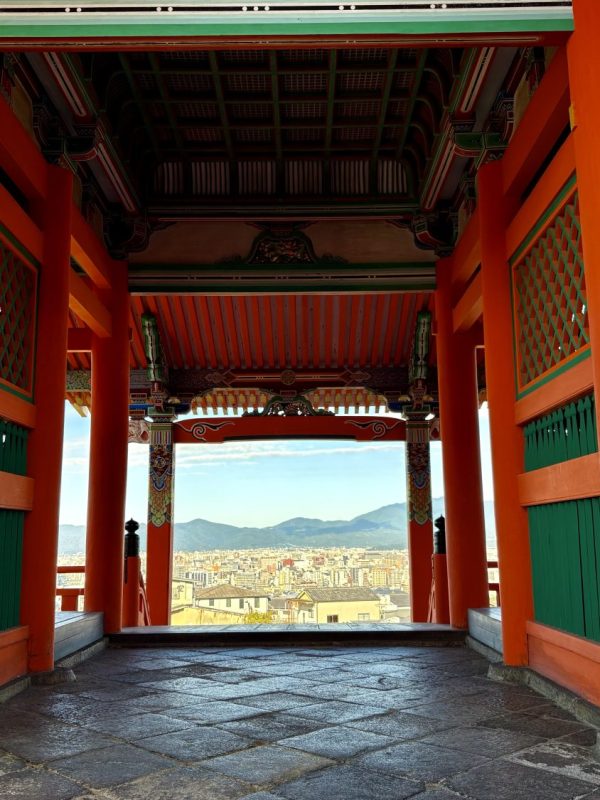
Satoshi, our hired taxi driver, picks us up early the next day and we tour the main sights of Kyoto with him, starting at the Kyomizo-dera temple. We beat some of the crowds and are rewarded with great light. The vermillion (reddish orange) paint that is used liberally on the shrines and torii gates looks best early morning and late afternoon. The colour is meant to symbolize the power of fire, blood & the sun.
From there we battle morning traffic for a trip to Otagi Nenbutsu-ji temple where 1,200 carved statues cover the hillsides. Called rakan, they represent enlightened Buddhist disciples, and were created by pilgrims carving under the guidance of Kocho Nishimura in the 1980s. Each rakan is unique; some posed deep in serious prayer, others smiling, laughing, or holding objects that reflect the carvers’ interests.
Next up is the Kinkaku-ji temple, aptly called the golden temple because the top two floors are completely covered in gold leaf. The temple was the retirement villa of the shogun Ashikaga Yoshimitsu, and according to his will it became a Zen temple of the Rinzai sect after his death in 1408. Beautifully sited on a large pond and with the morning sun glinting off the gold leaf, it is uber photogenic.
We carry on to the famed Arashiyama Bamboo Grove where once again we jostle with hundreds of other tourists. It is impossible to find a quiet moment in what should be a place of peace and tranquillity. And because it is October the bamboo has shed a lot of leaves and looks nothing like the photos that win photography prizes. It’s a bit of a disappointment. As is jostling for lunch along a strip of very touristy restaurants, where we get a so-so meal for a lot of yen.
Satoshi has failed to take into account that Craig & I take a lot of photos so we run a bit short of time at the end of the day and decide to skip the Imperial Palace. Instead he drops us at the Fushimi Inari Shrine, dedicated to the Shinto god of rice and home to 1000 vermillion torii gates. I don’t count them all so cannot verify the exact number but it does take almost an hour to walk the path through them. By now it is late in the day and the crowds have ebbed.
A first Craig & I decline a trip to Nara, a town 40 minutes away by train, and advertised as an opportunity to interact with the friendly sika deer populating the city. In Vernon we have deer in our front garden daily. Sure, we can’t pet them and are even a bit afraid of them, but we can’t imagine going out of our way to spend time with deer.
Because Nara is also home to a famously large Buddha statue, we tag along with Seonag & Geoff. Housed in the Todaiji Temple, the Buddha is made of gilt bronze and stands fifty feet tall. His right hand is gesturing “do not be afraid,” and his left “I will grant people’s wishes”. The Buddha is kept company by a number of other statues in an impressively huge wooden structure said to be one of the largest in the world.
Equally impressive are the deer. We joke about adopting a baby deer to bring home with us, to keep Chichi company, and to start a tradition of rescued animal travel souvenirs. All joking aside, the fawns are adorable. There are hundreds of deer (1,300 approximately), mostly in the park adjacent to the train station, and mostly hovering around the stalls where 200 yen buys a package of deer biscuits. The photos don’t really do the experience justice. Seonag gets nipped in the butt and I take a nip to the thigh. Not serious bites, but startling reminders that they are “wild” animals. The deer are protected and even revered by the locals because an 8th century Shinto god is alleged to have arrived in Nara riding a white deer.
Back in Kyoto for our last afternoon, even though we are tired, we take in one last temple. The Sanjusangendo Temple houses 1,001 statues of Kannon, the goddess of compassion in her thousand-armed incarnation. The statues are displayed in a 130 meter long hall, the longest wooden structure in Japan and in the world. Sadly, security cameras and signs warning of fines dissuade me from sneaking a photo. I’ve snatched one from the internet, which kinda feels like cheating, but you know what they say about a picture … it paints a thousand words!
Three days in Kyoto, two of which we logged 18,000 steps (Craig steps, I figure I did 25,000), are gone in a flash. With 2,000 religious sites, including roughly1,600 Buddhist temples and 400 Shinto shrines, it’s not possible to take it all in. Another scratch the surface experience in a fascinating city.


Charlotte Sutcliffe says:
You captured great photos. Packed in slot of sights in three days. Kyoto looks very clean and well kept. The deer are adorable! Look forward to more of your vacation pics and stories. Safe travels
Sharon & Ray Brubacher says:
The colours! and
The beauty!!!