We’ve long talked about a trip to Japan and this year we make it happen. Friends from Toronto, Seonag & Geoff, are also keen to travel to Japan and we are happy to have their companionship. And so, at last, we are here in Japan, “land of the rising sun”, so named because of the islands’ (there are 14,125 of them) location, the far east of Asia. The sun rises here first.
It’s a long 11 hour flight to Tokyo from Vancouver, over a part of the Pacific that is devoid of land. Any mid-flight problems and we are bailing into the ocean, a thought that I have to work at repressing. Made easier by watching 5 movies and eating two meals, in my own pod, in Air Canada business class. We land at Narita International Airport, on Honshu, the largest island. From here it is an hour and a half train ride into Tokyo.
Originally known as Edo, Tokyo is the largest city and capital of Japan. With a population of 40 million plus in the larger metropolitan area, Tokyo is a massive city. Each of the neighbourhoods, called “wards” are large cities themselves. A subway system resembling a bowl of spaghetti connects it all. Our hotel, the Sotetsu Fresa Higashi https://en.sotetsu-hotels.com/fresa-inn/higashishinjuku/ is centrally located and basic but clean & comfortable.
At 35 degrees latitude, Tokyo is still warm, the leaves still green, the air very humid. We’ve just missed a typhoon and a month of daily rain. No wonder it is so lushly verdant!
Language, the subway, the toilets, the food, the ubiquitous vending machines … all are somewhat baffling. My four word vocabulary – konichiwa (hello), arigato (thank you), mizu (water), biru (beer) – only get me so far, and I don’t even drink beer! We ride the subway for free the first day because we cannot figure out how to pay. The toilets have way more instructions than seems necessary but the little squirt of water at the end is kinda nice. The food is a challenge and we end up with a few not great meals. In four days I eat three plates of Spaghetti Bolognaise and two curries.
Also baffling and creepy and disturbing are the young girls dressed like baby-dolls. They stand on the street holding signs with prices that we assume are for some kind of erotic service. These ones look like hookers, while others look like they are cosplaying. Either way it is a strange fetish.
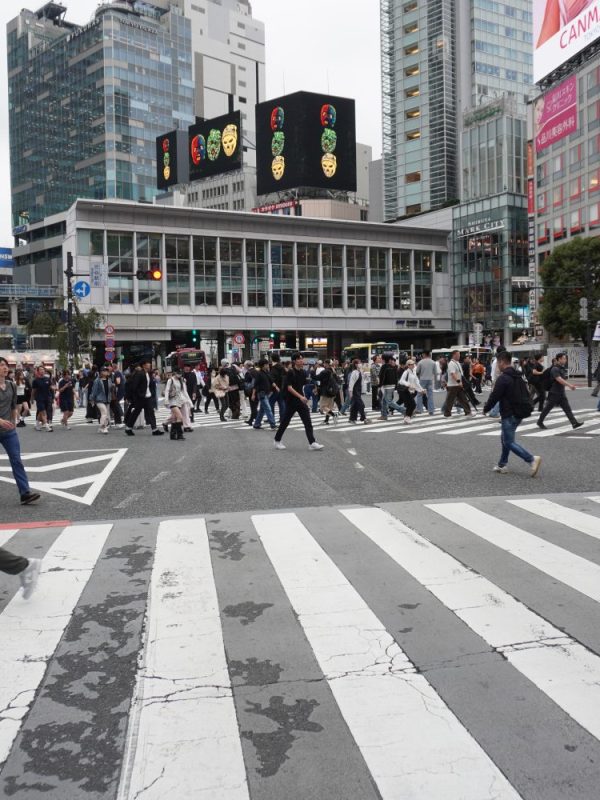
As for the sightseeing, we pack a lot in our four days in Tokyo. We hit the pavement day one by walking to the Meiji Jingu Shinto Shrine, located in a peaceful park close to our hotel. From there we walk to the famed Shibuya scramble crossing, the world’s busiest pedestrian intersection, with as many as 3,000 people crossing during a single green light cycle. Finding a Starbucks that conveniently overlooks the intersection, we get a bird’s eye view. It’s a quiet morning and jet-lag has us here early so there are nowhere near that number of people crossing.
Next is a free subway ride to the Tokyo Skytree, a 634 metre structure providing 360 degree views of the city. It is the tallest tower in Japan and in the world, and the third tallest structure in the world. Cloudy weather spoils the views and the glass bottomed floor is teeny tiny, but it’s a must-see for tourists so we pay the entrance fee, head up on the elevator and do our best with our cameras.
Later that evening we wander the alleys of Shinjuku marvelling at the lights, the crowds, the baby-doll girls, a giant Godzilla peering over one of the buildings. A yakitori dinner at a hole-in-the-wall restaurant is delicious and feeds four of us for less than $80.
Day two dawns clear & sunny, perfect weather for a day trip to Mount Fuji, an active volcano with an exceptionally symmetrical cone. The last eruption was in 1707, leaving us to wonder if it is either no longer active or due to erupt any minute. The mountain is a Japanese cultural icon frequently depicted in art and photography. Hassan, our driver & guide, tells us that Fuji is only visible 80 days of the year, less than a quarter of the time. We’re pretty sure he is trying to lower our expectations and sure enough when we get to the viewpoint we see only clouds.
A visit to a local village, a lake-side curry lunch, a trip down into an ice cave … none of these compensate for not seeing Fuji. Not even a drink of pure untreated Fuji water assuages our disappointment. The best part of the trip is a final stop at a viewpoint that happens to be in front of a Lawsons convenience store, in the parking lot. We see a crowd of tourists taking photos and wonder what they are seeing that we are not. Fuji is obscured with clouds. But they are posing and clicking. It’s quite hilarious. It’s even funnier when we find ourselves in their midst, taking photos of them taking photos of a cloud-shrouded Fuji.
We’re still jet-lagged and up early, so day three we’re off to the Tokyo Dome, home of the Tokyo Giants baseball team. I buy a few souvenirs in the merch shop and chat with the cashier about the Blue Jays. Inevitably the conversation turns to the Dodger’s star Shohei Ohtani. Lunch is a subway ride away at the massive Tokyo train/bus/subway station.
Next is a tour the nearby Imperial Palace grounds, where we learn a bit about the history of the hierarchy of power in ancient Japan: the shoguns and the emperors. Whereas the emperor held sacred and symbolic authority, the shogun wielded military and political power. When Japan opened up to the outside world the shogunate system fell by the wayside.
Today power is held by an elected Prime Minister, currently a woman, a first for Japan. Japan’s emperor, the 126th monarch in the traditional line of succession, has little power as his position is largely ceremonial. He has a daughter but no sons and there is much discussion about whether or not she will be crowned empress. Paradoxically the current prime minister’s party is not in favour of her succession to the throne, even though the party is led by a woman. Pretty hypocritical, imho!
Day four is another early start, on the subway (by now we have bought day passes & figured out how to read the subway maps) headed to the Tsukiji fish market, one of the largest in the world. Until 2018 it was the largest, only to be surpassed by the Toyosu fish market, also in Tokyo. Not surprisingly our sushi lunch is made fresh while we wait, and watch, and is delicious.
My travel companions all pass on a final night out on the street. They are tired but I am restless and hungry and Tokyo is so safe that I head out for a few hours with my cameral, starting on the roof of the Granbell Hotel. It’s an indulgent luxury to sit alone with nowhere to be, no agenda to attend to, no cares or worries. Just a glass of bubbly, a bowl of chicken curry and my own meandering thoughts.
Four days in Tokyo is not enough time to see all there into see, to do all there is to do, experience all there is to experience. It’d take weeks, months and maybe even years to fully explore this mega metropolis. But four days is all we have and we’ve crammed in as much sightseeing as we can, happy to just scratch the surface of this vibrant, chaotic and fascinating city.